
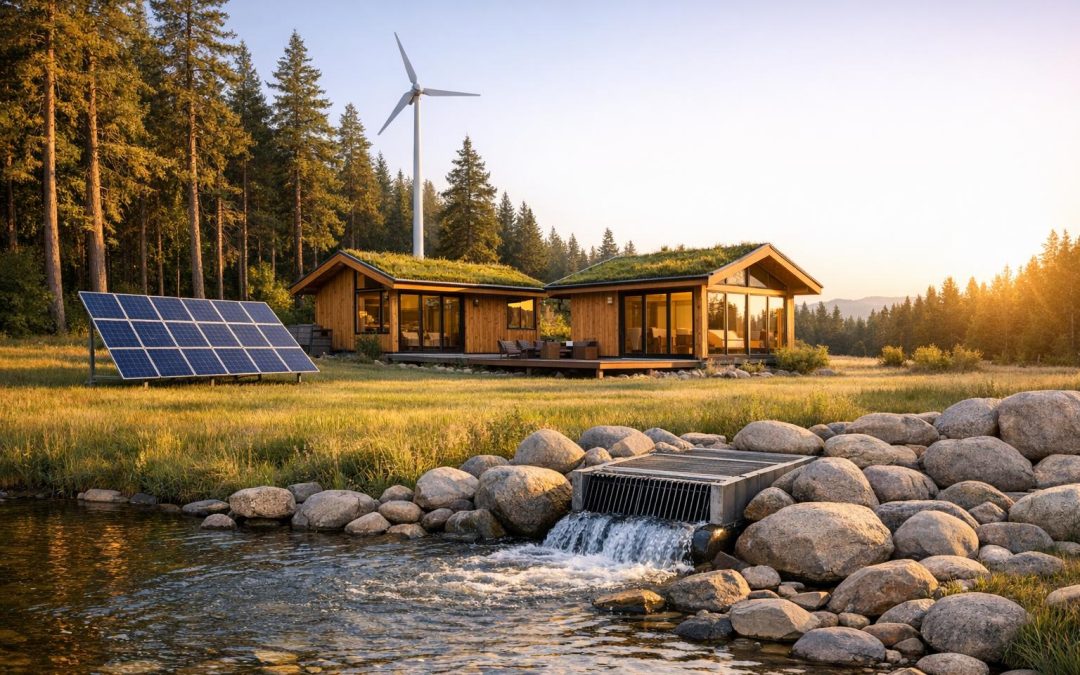
Looking for reliable and eco-friendly energy solutions for retreat centers? Here’s a quick rundown of five renewable energy systems that can provide consistent power, reduce costs, and align with guest preferences for sustainable practices:
- Solar Power Systems: Ideal for sunny locations, these systems are cost-effective and highly scalable. Installation costs range from $15,000–$60,000, with federal credits available.
- Wind Turbines: Suitable for areas with strong, consistent winds. Costs vary between $30,000–$150,000 for small-scale setups.
- Micro-Hydro Systems: Perfect for centers near water sources. These provide 24/7 power and are highly efficient, with costs ranging from $1,000–$5,000 per kW.
- Geothermal Energy Systems: Great for heating and cooling, these systems offer long-term savings but have high upfront installation costs.
- Biomass Energy Solutions: A practical choice for centers with access to organic materials, offering consistent power with moderate installation costs ($15,000–$25,000).
Quick Comparison:
| Energy System | Power Output | Installation Cost Range | Maintenance Effort | Best For |
|---|---|---|---|---|
| Solar | Daytime (Intermittent) | $15,000–$60,000 | Low | Sunny, remote locations |
| Wind | Day/Night (Intermittent) | $30,000–$150,000 | Moderate | Windy, open areas |
| Micro-Hydro | 24/7 (Continuous) | $1,000–$5,000 per kW | Low | Near flowing water |
| Geothermal | 24/7 (Continuous) | High (site-specific) | Low | Heating/cooling needs |
| Biomass | 24/7 (Continuous) | $15,000–$25,000 | High | Areas with organic resources |
Each system has unique strengths, making it essential to evaluate your location, energy needs, and budget. Combining multiple systems can maximize reliability and efficiency. Keep reading to find detailed insights and real-world examples for each option.
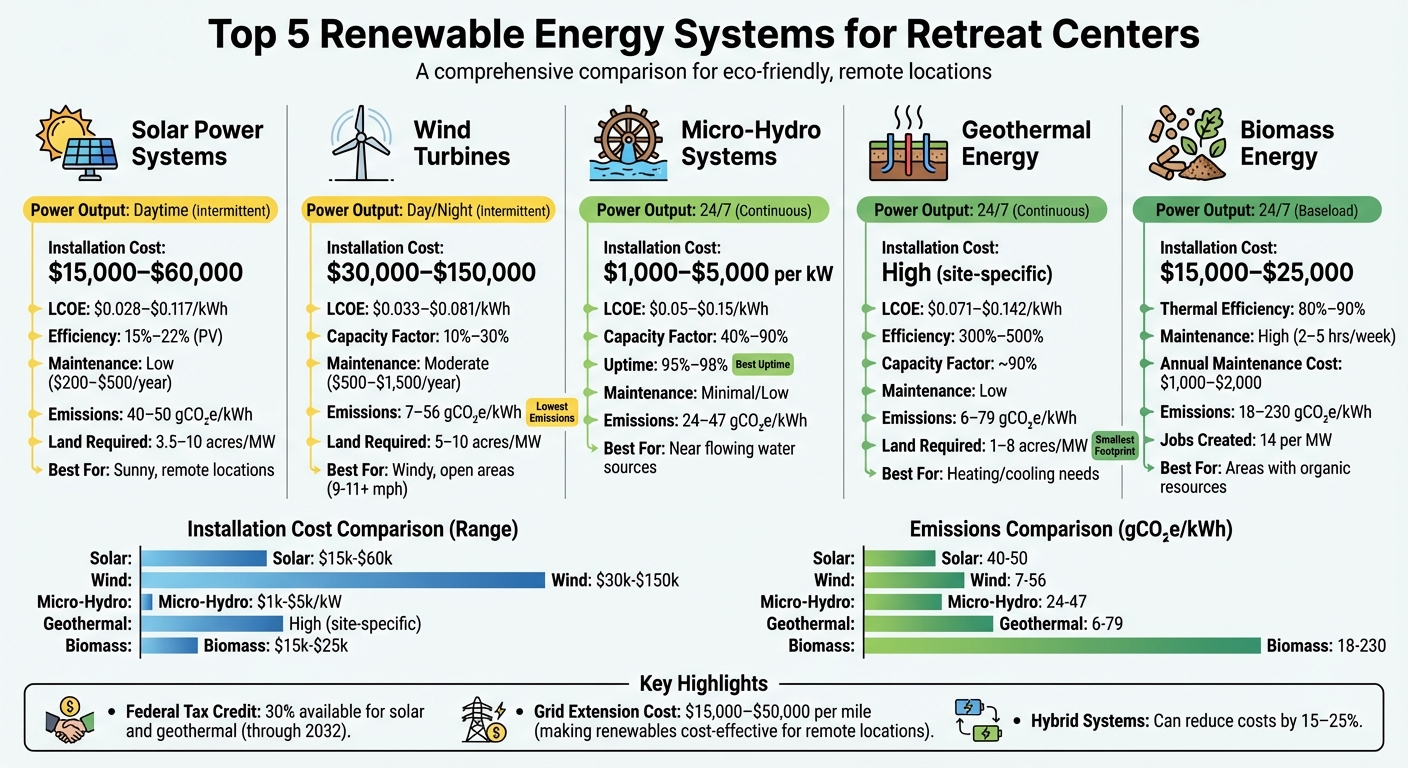
Renewable Energy Systems Comparison for Retreat Centers: Costs, Output & Efficiency
1. Solar Power Systems
Energy Efficiency and Output
Solar power systems work by converting sunlight into usable energy, with efficiency rates that depend on the type of system. Photovoltaic (PV) systems typically achieve 15%–22% efficiency, generating electricity directly from sunlight. Meanwhile, solar thermal systems, which are used for heating water and buildings, can reach efficiency rates of 40%–80%. However, the actual energy output varies significantly based on location. For example, a retreat center in sunny Arizona might enjoy 6–7 peak sun hours daily, while those in northern regions may only receive 3–4 hours.
To put this into perspective, a 400W solar panel can produce about 1.2–1.6 kWh per day under ideal conditions. If you use tracking systems that follow the sun’s movement, you can increase this output by 15%–25%. For retreat centers aiming to go completely off-grid, the system must be sized to meet 100% of energy needs, which typically requires larger solar arrays and battery storage compared to grid-tied setups. These numbers highlight how solar power can be a practical energy solution, especially for remote locations.
Suitability for Remote or Natural Locations
Solar power is especially well-suited for retreat centers located in remote areas, where extending power lines can be prohibitively expensive – costing anywhere from $15,000–$50,000 per mile. This makes solar systems an attractive alternative, particularly for locations with unreliable grid access or frequent blackouts.
Take the Birken Forest Monastery in British Columbia as an example. Situated at an elevation of 4,000 feet, the monastery expanded its off-grid solar system in 2014 to include an 11.4 kW array and a 40 kWh battery bank. Even in December, when they receive just 1.5 hours of bright sunshine per day, the system reduced diesel generator use from 60 hours per month to just 10 hours. Supporting 12–15 residents with an average daily energy demand of 12 kWh, the monastery achieves this efficiency through measures like using super-efficient appliances and insulating shutters. As Ajahn Sona, the monastery’s Abbot, explained:
"The brutal reality of high-cost electricity (70 cents per kWh) turns you into an inventor/economist/minimalist, overnight".
This example shows not only the energy benefits of solar but also its role in creating a stable, low-impact energy solution that aligns with the eco-conscious goals of many retreat centers.
Installation and Maintenance Costs
While solar energy offers efficiency and reliability, installation and maintenance costs are key factors to consider. Off-grid solar systems typically cost between $30,000–$60,000 for whole-home setups. This is about twice the cost of grid-tied systems due to the need for battery storage. Larger retreat centers will face higher upfront costs, but federal incentives can help offset these expenses. For instance, the 30% Residential Clean Energy Credit applies to both solar panels and battery storage through 2032, providing significant financial relief.
The type of battery you choose also impacts long-term costs. Lithium Iron Phosphate (LiFePO4) batteries are highly recommended for off-grid systems. These batteries require no maintenance, last up to 10 years, and can discharge up to 80% of their capacity – far outperforming traditional lead-acid batteries, which can only discharge about 50%. However, battery banks will need replacement every 10–15 years, representing a major capital expense. To ensure reliability during prolonged cloudy periods, it’s wise to include a gas or propane generator as a backup.
For year-round performance, design your system to handle energy demands during the darkest month – usually December or January. Reducing your energy needs with LED lighting and energy-efficient appliances can also lower the size and cost of your solar array.
sbb-itb-77c7b55
Inside OAEC’s Solar Microgrid: Powering an 80-Acre Farm & Retreat Space with Clean Energy
2. Wind Turbines
After exploring solar systems, wind turbines emerge as another renewable energy option worth considering for retreat centers.
Energy Efficiency and Output
Wind turbines require consistent wind speeds of at least 9-11 mph (4-5 meters per second) to generate a useful amount of electricity. Interestingly, as wind speed increases, power output grows exponentially – doubling the wind speed results in eight times more power. Because of this, assessing wind conditions is crucial before making an investment.
The most common type of wind turbine, Horizontal Axis Wind Turbines (HAWTs), typically delivers better performance compared to Vertical Axis Wind Turbines (VAWTs). For residential or small-scale setups, turbines with 10%–30% capacity factors often need a 10kW to 20kW system to supply sufficient power for multiple structures. Pairing wind turbines with solar panels and a battery backup can improve reliability and ensure a steady power supply.
Next, let’s look at how wind turbines fit into remote or nature-focused locations.
Suitability for Remote or Natural Locations
Wind turbines are particularly practical for off-grid retreat centers that lack easy access to the power grid. However, they do come with space and placement requirements. For instance, you’ll need at least 1 acre of land to allow for proper tower setbacks and to minimize turbulence. The turbine itself should stand at least 30 feet above any obstacles within a 300-foot radius to avoid losing efficiency. This can be tricky for locations surrounded by forests or situated in valleys, where natural obstructions can disrupt wind flow. A professional wind resource assessment using tools like anemometers is essential to gauge the feasibility of wind energy in such areas. It’s also important to check local zoning laws and height restrictions early in the planning process.
Installation and Maintenance Costs
Installation and maintenance costs play a major role in deciding whether wind turbines are a practical choice for retreat centers.
The average cost to install a residential wind turbine is around $35,000. For retreat centers, a 10kW system typically costs between $30,000 and $150,000, while a 20kW system ranges from $50,000 to $80,000, depending on factors like tower height and site complexity. About 30% of the total project cost usually goes toward foundations, grid connections, installation, and permits.
On a smaller scale, wind systems cost approximately $7,850 per kilowatt, which is significantly higher than the cost of utility-scale systems. For these systems to make financial sense, the site should have average wind speeds above 12 mph and electricity rates over $0.12 per kWh. Payback periods can vary widely, typically falling between 10 and 20 years.
Annual maintenance is another factor to consider. Service calls for tasks like lubricating parts and checking blade balance cost between $200 and $500. Adding in insurance and monitoring, annual operating costs range from $200 to $1,000.
3. Micro-Hydro Power Systems
For retreat centers located near flowing water, micro-hydro power systems present a dependable renewable energy option that provides a consistent power supply around the clock.
Energy Efficiency and Output
Micro-hydro systems typically generate between 5 and 100 kW of power. For example, a 10-kW system has enough capacity to supply energy to a large home, a small resort, or a retreat center. One of their standout features is their ability to deliver "base load" power, meaning they provide a steady energy supply 24/7 as long as the water source is flowing. These systems boast impressive reliability, with uptime rates of 95% to 98%, and capacity factors ranging from 40% to 90%. This far surpasses the performance of solar (15–25%) and wind (20–40%) systems. Turbine efficiency varies between 50% and 90%, with high-quality options like Pelton and Kaplan turbines achieving efficiencies on the higher end.
Most micro-hydro installations use a "run-of-river" design, which diverts part of the stream’s flow through a turbine before returning it to the watercourse. This eliminates the need for large dams or reservoirs. The power output depends mainly on two factors: "head" (the vertical drop) and "flow" (the volume of water passing through per unit of time). A simple way to estimate power is by using the formula: (Head [ft] × Flow [GPM]) / 10.
These systems can function with as little as 2 feet of vertical drop and 2 gallons per minute of water flow. Because their performance is not tied to weather conditions, micro-hydro systems are an excellent addition to solar and wind setups, which can be less consistent.
Suitability for Remote or Natural Locations
Micro-hydro power is especially useful for remote retreat centers where connecting to the grid is either too costly or not feasible. Unlike solar or wind systems, micro-hydro provides continuous, weather-independent energy. Additionally, water flow tends to peak during winter months when solar output is at its lowest, making micro-hydro an ideal partner in hybrid renewable systems. Conducting a year-round flow study is essential before installation to understand seasonal changes in water availability. If an existing structure, such as an irrigation canal, is available, "conduit exemptions" can speed up regulatory approvals, often reducing the process to 6–12 months. For systems with batteries, positioning the battery bank near the turbine reduces energy loss during low-voltage transmission.
Centers with access to abundant water resources, like Elohee Retreat Center in North Georgia (https://elohee.org), can greatly benefit from the steady energy micro-hydro provides. When combined with solar and wind, it creates a well-rounded renewable energy solution for off-grid locations.
Environmental Impact
Micro-hydro systems operate without producing any direct emissions or greenhouse gases. The run-of-river design minimizes environmental disruption compared to large dam projects, and many systems offset their manufacturing emissions within the first year of operation. However, improper water diversion can harm downstream ecosystems or interfere with fish migration. Installing Coanda screens or trash racks at intake points prevents debris and fish from entering the turbine. Ensuring a minimum stream flow is also crucial for maintaining aquatic life. Consulting a professional is key to meeting regulatory standards and designing a system that minimizes ecological impact.
Installation and Maintenance Costs
The installation costs for micro-hydro systems generally range from $1,000 to $5,000 per kW of capacity. For small-scale projects, total costs typically fall between $1,000 and $20,000, depending on site-specific factors. Over time, the Levelized Cost of Energy (LCOE) is estimated at $0.05 to $0.15 per kWh, making micro-hydro one of the most cost-efficient renewable energy options. Maintenance is relatively straightforward and primarily involves cleaning intake screens to remove debris. A well-designed system can last 25–50 years, offering a reliable and long-term energy solution.
4. Geothermal Energy Systems
Geothermal systems take advantage of the Earth’s stable underground temperature – around 50°F – to provide consistent heating and cooling throughout the year. This makes them a reliable choice for retreat centers needing steady climate control to enhance guest comfort.
Energy Efficiency and Output
Geothermal heat pumps operate with impressive efficiency, delivering three to five times the energy they consume (300%-500%). Unlike solar or wind energy, geothermal systems provide dependable baseload power. The U.S. Department of Energy’s Office of Geothermal highlights this reliability:
"Geothermal energy provides baseload power and delivers a high capacity factor – typically ~90% – meaning that geothermal power plants can operate at maximum capacity nearly all the time".
Ground loops, a key component of these systems, often last over 50 years, while heat pump units generally have a lifespan of 20 to 25 years.
A standout example is the Peppermill Resort Spa Casino in Reno, Nevada. In 2010, the resort invested $9.7 million to drill 4,400 feet into a geothermal reservoir. This system now supplies 100% of the heating energy for the 2-million-square-foot property, covering pools, hot tubs, and domestic water. The project saves the resort $2.2 million annually in natural gas costs and reduces its carbon footprint by 12,000 metric tons of CO₂ each year. Such consistent performance makes geothermal systems particularly appealing to retreat centers focused on sustainability.
Suitability for Remote or Natural Locations
Geothermal systems are especially effective in preserving the natural environment. They require less land than solar or wind installations, particularly when vertical ground loops are used, making them ideal for locations that prioritize minimal land disturbance. Their compact design and quiet operation ensure they blend seamlessly into the surroundings, maintaining the tranquility of places like Elohee Retreat Center in North Georgia (https://elohee.org).
For retreat centers, geothermal systems offer dual benefits. They can generate electricity while also providing direct heat for space heating, hot water, and even thermal spa applications. Closed-loop systems, which don’t rely on natural reservoirs, further expand the range of possible installation sites.
Environmental Impact
Geothermal systems are among the cleanest renewable energy options, producing no direct emissions or pollutants during operation. By switching to geothermal heat pumps, buildings can cut energy consumption by 70%-80% compared to traditional systems. The main environmental consideration is the land needed for ground loop installation. However, vertical loops significantly reduce this footprint. Conducting a geological survey is essential to confirm that soil conditions are suitable for installation.
Installation and Maintenance Costs
The upfront costs of geothermal systems can be substantial, with drilling and installation making up more than 70% of the total expense. However, payback periods for tourism-related projects typically range from 5 to 10 years. To ease the financial burden, a 30% federal tax credit is available for geothermal installations.
Once installed, maintenance costs are low, and the long-term savings on energy bills often outweigh the initial investment. For retreat centers committed to sustainability, focusing on "direct use" applications – like heating and spa facilities – can yield faster returns compared to small-scale electricity generation. This approach aligns with the eco-conscious goals of many nature-focused retreats.
5. Biomass Energy Solutions
Biomass systems present another reliable option for retreat centers exploring renewable energy sources. These systems convert organic materials into heat and power, making them a practical choice for centers with access to local organic resources. By utilizing biomass, retreat centers can achieve energy independence while also contributing to the local economy.
Energy Efficiency and Output
Modern biomass systems are impressively efficient, achieving thermal efficiencies of 80% to 90% for heating applications. Unlike wind or solar energy, biomass provides consistent power around the clock, unaffected by weather or daylight. This makes it particularly suitable for retreat centers in colder climates with high heating demands.
Currently, biomass accounts for about 5% of total U.S. primary energy consumption, with wood and wood-derived fuels making up 45% of all biomass energy use. Systems using fuel with 40% moisture content typically operate at a net efficiency of 60%–65%. For optimal performance and cost-effectiveness, wood-fired boilers should be sized at 50% to 80% of peak load, which allows them to meet 90% to 95% of annual heating needs while maintaining efficiency and reducing capital costs.
Suitability for Remote or Natural Locations
Biomass systems are particularly advantageous for retreat centers in remote areas, where organic materials like fallen trees, brush, or food scraps can be converted into energy. This approach not only reduces waste but also creates a circular system where organic materials are repurposed for energy instead of decomposing in landfills and emitting methane.
Additionally, biomass supports local economies by creating jobs. Each megawatt of installed biomass capacity generates approximately 14 jobs, compared to only 3–4 jobs for solar energy systems. Using locally sourced fuel keeps energy spending within the community and boosts employment in fuel collection and processing. For example, the Elohee Retreat Center in North Georgia could utilize its 220-acre property for sustainable forest management while preserving its natural beauty.
Environmental Impact
Biomass is often labeled carbon-neutral because the CO₂ released during combustion is offset by the CO₂ absorbed by plants during their growth. The environmental benefits are maximized when using waste materials and by-products rather than crops grown specifically for energy. A study from Denmark’s Nordjylland Power Station in 2022 found that producing 1 MJ of heat from wheat straw emitted only 22.73 g of CO₂e, compared to 117.01 g for coal – an 80% reduction.
However, emissions from biomass combustion can include particulate matter, carbon monoxide, and nitrogen oxides if not managed properly. Modern EPA-certified systems with advanced emissions controls like cyclones or baghouses are essential to meet environmental standards. Using seasoned hardwoods or pellets with less than 10% moisture content can also help ensure cleaner burns and reduce ash production.
Installation and Maintenance Costs
Installing a biomass heating plant typically costs between $500 and $1,500 per kW-thermal of capacity. For smaller retreat centers under 10,000 square feet, residential pellet boiler systems range from $15,000 to $25,000 installed. While initial costs are higher than fossil-fuel systems, the lower fuel expenses can bring the levelized cost of energy down to $10 to $20 per million Btu.
Maintenance requires a more hands-on approach compared to solar or wind systems. Expect to dedicate 2 to 5 hours per week during the heating season for tasks like ash removal and fuel handling. It’s also wise to set aside a maintenance fund of $1,000 to $2,000 annually for replacing parts like seals, bearings, and gaskets. Fuel storage should cover at least three days of operation to prevent disruptions during severe weather. Additionally, cleaning boiler tubes twice a year is crucial to maintain efficiency.
The table below compares biomass systems with solar PV systems:
| Feature | Biomass Systems | Solar PV Systems |
|---|---|---|
| Availability | 24/7 Baseload (Dispatchable) | Intermittent (Weather/Daylight dependent) |
| Upfront Cost | Lower ($15k–$25k for home heating) | Higher ($25k–$40k with battery storage) |
| Maintenance | High (Ash removal, fuel handling) | Low (Minimal moving parts) |
| Fuel Cost | Ongoing (Purchasing/procuring fuel) | Zero (Sunlight is free) |
| Efficiency | 70%–90% for heating | 15%–22% for electricity |
Comparison Table
This table provides a side-by-side look at five renewable energy systems, focusing on energy output, installation costs, and other key factors. The details here complement the earlier discussion.
| Energy System | Energy Output Type | Installation Cost Range | LCOE ($/kWh) | Emissions (gCO₂e/kWh) | Land Footprint | Annual Maintenance |
|---|---|---|---|---|---|---|
| Solar PV | Intermittent (Daytime) | $15,000 – $35,000 | $0.028–$0.117 | 40–50 | 3.5–10 acres/MW | $200–$500 |
| Wind Turbines | Intermittent (Day/Night) | $30,000 – $80,000 | $0.033–$0.081 | 7–56 | 5–10 acres/MW | $500–$1,500 |
| Micro-Hydro | Continuous (24/7) | $20,000 – $30,000 | $0.044–$0.254 | 24–47 | Variable | Minimal/Low |
| Geothermal | Continuous (24/7) | High (site-specific) | $0.071–$0.142 | 6–79 | 1–8 acres/MW | Low |
| Biomass | Continuous (Baseload) | $15,000 – $25,000 | Variable | 18–230 | Variable | High (labor-intensive) |
When it comes to emissions, wind energy stands out with the lowest lifecycle emissions at 7–56 gCO₂e/kWh. On the other hand, geothermal systems require the least land, needing just 1–8 acres per megawatt – far less than solar or wind. Both geothermal and micro-hydro systems also offer 24/7 baseload power, with geothermal achieving capacity factors over 90%, making it far less affected by weather compared to solar and wind.
"Wind energy achieves the lowest lifecycle emissions." – SolarTech Online
For retreat centers prioritizing affordability, solar and biomass systems are appealing, with installation costs ranging from $15,000 to $35,000 and $15,000 to $25,000 respectively. However, micro-hydro systems can deliver more energy for every dollar spent over time, thanks to their continuous energy production – provided a suitable water source is available.
From a cost perspective, the levelized cost of electricity (LCOE) highlights the long-term value of onshore wind ($0.033–$0.081/kWh) and solar PV ($0.028–$0.117/kWh). For retreat centers, combining multiple energy sources into a hybrid system – like solar, wind, and storage – can reduce overall costs by 15–25% by sharing infrastructure.
One example is the Elohee Retreat Center in North Georgia (https://elohee.org), which spans 220 acres of diverse ecosystems. For properties like this, a hybrid approach can improve energy reliability while keeping costs manageable. By leveraging the strengths of different renewable systems, retreat centers can create a sustainable and efficient energy plan.
Next, we’ll explore ways to integrate these systems into your retreat center’s energy strategy.
Conclusion
Renewable energy systems bring two standout benefits to retreat centers: reduced long-term operating costs and alignment with environmental priorities. Since 2010, the cost of solar photovoltaic (PV) systems has dropped by 90%, and onshore wind energy costs have decreased by 70%. This makes renewables not just an environmentally responsible choice but a financially smart one too. For perspective, a 1 MW solar installation can prevent about 1,500 tons of CO₂ emissions annually, which is comparable to taking 300 cars off the road.
The financial perks go beyond energy savings. Retreat centers in remote areas can sidestep the hefty expense of utility line extensions, which can range from $15,000 to $50,000 per mile. Additionally, U.S. incentives, such as the 30% Residential Clean Energy Credit for solar and battery installations (available through 2032), now allow non-profits to receive direct payments. These programs make adopting renewable energy systems far more accessible.
"We see this solar + storage system as an expression of our values and our emphasis on taking responsibility for our choices by doing full cost accounting to reveal externalized environmental and human costs." – Dave Henson, Executive Director, Occidental Arts & Ecology Center
To get started, conduct an energy audit to identify your daily kWh requirements. Next, assess your site’s natural resources – sunlight, wind, or water flow with sufficient drop. Simple upgrades, like switching to LED lighting and high-efficiency appliances, can reduce energy consumption by up to 70%, making it easier to achieve full reliance on renewable energy. These steps are essential for creating a hybrid system that taps into your site’s renewable energy potential.
For example, the Elohee Retreat Center (https://elohee.org) in North Georgia, which spans 220 acres of diverse ecosystems, benefits from a hybrid approach that combines multiple renewable sources. By tailoring a renewable energy plan to your site’s unique conditions, you can achieve a sustainable and efficient energy solution.
FAQs
How do I size a renewable system for my retreat center?
To figure out the right size for a renewable energy system, start by estimating your center’s energy consumption. Look at your total usage in kilowatt-hours (kWh) over a typical period, like a month or year. Be sure to account for how energy is used throughout the day – think about appliances, heating, cooling, and lighting patterns.
Once you know your energy needs, pick system components, such as solar panels or wind turbines, that can handle or exceed that demand. Don’t forget to consider local conditions, like how much sunlight or wind your location gets. It’s also smart to plan for future energy needs and include batteries to store power, ensuring you have electricity even during times when sunlight or wind is limited.
Which option works best for off-grid power year-round?
An off-grid solar power system is a dependable solution for uninterrupted energy throughout the year. These systems capture sunlight via solar panels, store surplus energy in batteries, and operate without relying on the utility grid. Even in remote areas, solar power remains a reliable option, with battery storage ensuring electricity is available during overcast days or nighttime. When designed correctly, these systems deliver consistent energy access across all seasons, making them a perfect fit for retreat centers like Elohee.
What permits and incentives should I plan for in the U.S.?
When setting up renewable energy systems at locations like Elohee Retreat Center, it’s important to explore federal incentives. For example, the Investment Tax Credit (ITC) can offset up to 30% of eligible solar installation costs. Additionally, programs like the Production Tax Credit (PTC) and REAP are available for rural projects, offering further financial support.
To ensure a smooth process, coordinate early with local authorities and utility providers. This helps navigate local building codes, zoning requirements, and necessary permits, making it easier to secure approvals and take full advantage of available benefits.
Recent Comments